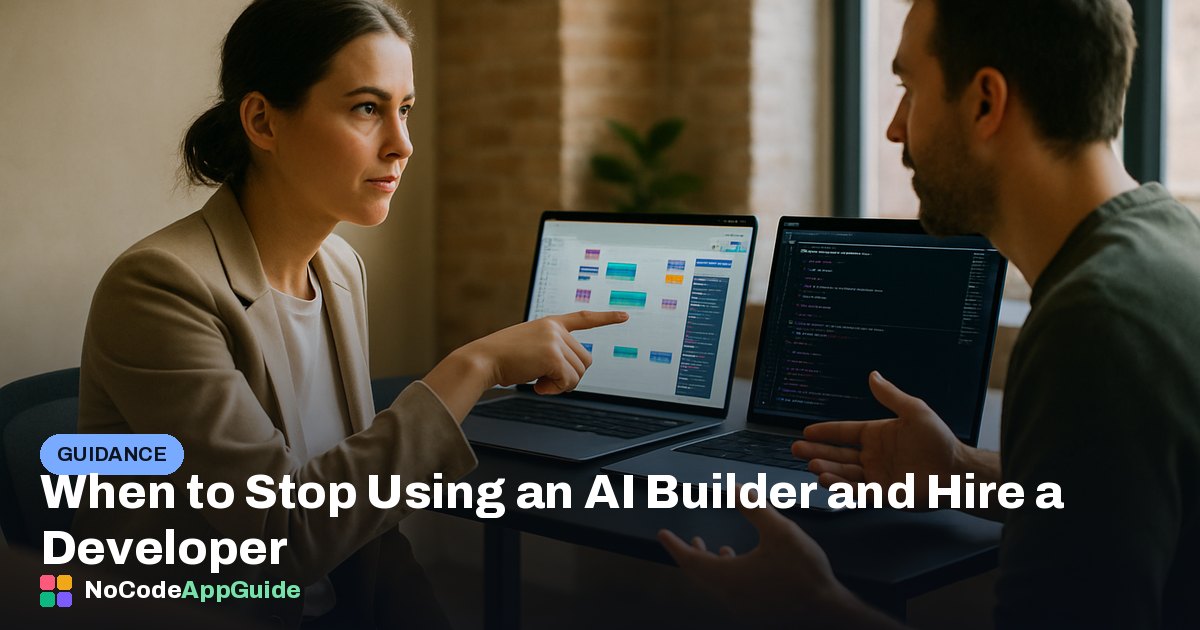
AI app builders are the right choice for early-stage products, internal tools, and founders validating ideas without a big budget. But when your app needs complex integrations, strict data compliance, or performance at scale, a professional developer will save you more time and money than any no-code platform. The honest answer is: use a builder to prove the idea, then hire engineering when the builder starts fighting you.
AI app builders are genuinely good enough to launch real products in 2026 — Lovable and Base44 have both helped non-technical founders ship working SaaS tools without writing a line of code. But every platform has a ceiling, and hitting it while your business is growing is expensive. Knowing when to switch from an AI app builder to a developer is one of the most important decisions a founder makes.
What AI Builders Are Actually Good At
Before listing the warning signs, it's worth being honest about the strengths. Modern AI builders handle a surprising amount:
Pros:
- Rapid prototyping — days instead of months to a working MVP
- Low upfront cost, especially at the validation stage
- Non-technical founders stay in control of their own roadmap
- Built-in hosting, auth, and database abstractions remove infrastructure headaches
Cons:
- Limited ability to write truly custom backend logic or complex algorithms
- Vendor lock-in can make migration painful later
- Performance tuning and database optimisation are largely out of your hands
See our full AI app builder comparison for a side-by-side breakdown of which platforms handle which use cases best.
Signal 1: Your Workarounds Are Multiplying
Every no-code app accumulates a little duct tape — a Zapier zap here, a manual CSV export there. That's normal early on. The warning sign is when those workarounds start compounding: you need a workaround to support a previous workaround, and the whole thing breaks if someone changes a field name. When fixing one thing reliably breaks another, you are no longer building a product; you are maintaining a fragile patchwork. A developer can replace that with clean, testable logic.
Signal 2: A Compliance or Security Requirement Blocks You
Healthcare apps needing HIPAA compliance, fintech tools requiring SOC 2, or any product storing EU user data under strict GDPR obligations will eventually run into walls on AI builder platforms. These platforms are improving their compliance stories, but they cannot give you the granular infrastructure control that an audit requires. If a prospective enterprise customer has sent you a security questionnaire you cannot answer, it's time to bring in an engineer.
Signal 3: Your Costs Are Scaling Faster Than Your Revenue
AI builder pricing is designed for early-stage products. As usage grows, platform fees, API call limits, and row counts can push monthly costs well above what a hosted custom app would cost. If you are paying four figures a month to a no-code platform and the bill is growing faster than revenue, the economics of custom development start to look attractive. Check our guide on what it actually costs to build an app with AI to benchmark where you stand.
Signal 4: You Need Performance the Platform Cannot Deliver
Slow queries, rate-limited third-party integrations, and inability to run background jobs on a custom schedule are common complaints once a product gets real traffic. AI builders abstract the database and server from you — which is convenient at first, but means you cannot add an index, optimise a query, or move a workload to a queue. If your users are complaining about speed and your builder's support team tells you there is nothing they can do, that is a hard ceiling.
How to Transition Without Starting Over
The good news is that switching does not always mean throwing away what you built. Many founders use their AI-built prototype as a detailed spec — the developer can see exactly what the product does and rebuild it properly. Others migrate incrementally, keeping the no-code front end while a developer rebuilds the backend. If you are still at the idea stage, start with a builder and use our guide on how to build a SaaS without code to get as far as you can before committing to engineering costs.
The bottom line: an AI app builder is the right tool until it starts costing you more — in money, time, or opportunity — than a developer would. Trust those signals when they arrive.
Frequently asked questions
Can I move my app from an AI builder to a custom codebase later?
Yes, but it usually means a partial or full rebuild rather than a clean export. The AI-built version works best as a detailed functional specification for your developer, saving significant scoping time.
How much does it cost to hire a developer compared to using an AI builder?
An AI builder typically costs between $20 and $500 per month depending on the platform and usage. A freelance developer might charge $5,000–$30,000 for an MVP, while an agency can cost significantly more. The builder wins on upfront cost; custom development often wins on total cost once traffic and complexity grow.
Are there AI builders suitable for more complex apps?
Some platforms handle moderate complexity well, especially those that let you write custom code alongside the AI-generated output. Check our full comparison to see which builders offer the most flexibility before deciding to hire out.
What kind of developer do I need when I outgrow a no-code tool?
For most early-stage SaaS products, a full-stack developer comfortable with a modern framework like Next.js or a backend like Node or Python is sufficient. If your bottleneck is specifically the database or infrastructure, a backend specialist or DevOps engineer may be more useful.
Is it possible to keep using an AI builder and hire a developer at the same time?
Yes, and it is often a smart hybrid approach. Some teams use an AI builder for the customer-facing front end while a developer builds and maintains the backend APIs, giving you speed on the UI side and control where it matters most.
Find the AI builder that fits your idea
We tested every major AI app builder head-to-head. See which one matches your project in our full comparison.